Featured
Table of Contents
is the best choice when you need a highly personalized frontend with intricate UI, and you're comfy putting together or connecting your own backend stack. It's the only framework in this list that works equally well as a pure frontend layer. AI tools are excellent at producing React parts and page structures.
The complexity of the App Router, Server Parts, and caching plus breaking changes like the Pages to App Router migration can also make it harder for AI to get things. Wasp (Web Application Spec) takes a various method within the JavaScript community. Instead of giving you building blocks and informing you to assemble them, Wasp utilizes a declarative setup file that describes your entire application: routes, pages, authentication, database models, server operations, and background tasks.
With and a growing community, Wasp is earning attention as the opinionated option to the "assemble it yourself" JS community. This is our framework. We developed Wasp because we felt the JS/TS ecosystem was missing the kind of batteries-included experience that Laravel, Rails, and Django developers have had for years.
define your whole app paths, auth, database, jobs from a high level types flow from database to UI instantly call server functions from the client with automatic serialization and type monitoring, no API layer to write email/password, Google, GitHub, and so on with minimal config state async jobs in config, execute in wasp release to Train, or other service providers production-ready SaaS starter with 13,000+ GitHub stars Considerably less boilerplate than assembling + Prisma + NextAuth + etc.
Likewise a strong suitable for small-to-medium groups constructing SaaS items and enterprises developing internal tools anywhere speed-to-ship and low boilerplate matter more than optimal customization. The Wasp configuration gives AI an immediate, high-level understanding of your whole application, including its routes, authentication approaches, server operations, and more. The well-defined stack and clear structure permit AI to focus on your app's organization reasoning while Wasp handles the glue and boilerplate.
Stabilizing Innovation and Security in Professional Web DesignModern Front-end Design Patterns for Higher Engagement
Among the most significant distinctions between frameworks is just how much they provide you versus just how much you assemble yourself. Here's a detailed contrast of key features across all five structures. FrameworkBuilt-in SolutionSetup EffortDeclarative auth in config 10 lines for email + social authMinimal state it, doneNew starter sets with email auth and optional WorkOS AuthKit for social auth, passkeys, SSOLow one CLI command scaffolds views, controllers, routesBuilt-in auth generator (Bed rails 8+).
Login/logout views, consents, groupsLow consisted of by default, include URLs and templatesNone built-in. Usage (50-100 lines config + route handler + middleware + service provider setup) or Clerk (hosted, paid)Moderate-High set up package, set up companies, include middleware, handle sessions Laravel, Rails, and Django have had over a years to fine-tune their auth systems.
Django's consent system and Laravel's group management are particularly advanced. That stated, Wasp stands out for how little code is needed to get auth working: a few lines of config vs. produced scaffolding in the other structures.
Sidekiq for heavy workloadsNone with Solid Queue; Sidekiq needs RedisNone built-in. Celery is the de facto standard (50-100 lines setup, requires broker like Redis/RabbitMQ)Celery + message brokerDeclare job in.wasp config (5 lines), execute handler in Node.jsNone utilizes pg-boss under-the-hood (PostgreSQL-backed)None built-in. Required Inngest,, or BullMQ + separate employee processThird-party service or self-hosted worker Laravel Lines and Rails' Active Job/ Solid Queue are the gold requirement for background processing.
Maximizing Flexibility with API-First Integration
FrameworkApproachFile-based routing develop a file at app/dashboard/ and the path exists. Path:: resource('photos', PhotoController:: class) provides you 7 CRUD routes in one lineconfig/ similar to Laravel.
Flexible however more verbose than Rails/LaravelDeclare path + page in.wasp config paths are combined with pages and get type-safe linking. Simpler but less flexible than Rails/Laravel Routing is mainly a fixed problem. Bed rails and Laravel have the most powerful routing DSLs. file-based routing is the most intuitive for basic apps.
FrameworkType Safety StoryAutomatic types flow from Prisma schema through server operations to Respond elements. No manual setup neededPossible with tRPC or Server Actions, but needs manual setup. Server Actions supply some type circulation but aren't end-to-endLimited PHP has types, but no automatic circulation to JS frontend. provides some type sharing with TypeScriptMinimal Ruby is dynamically typed.
Improving Digital Experiences through API-First Design
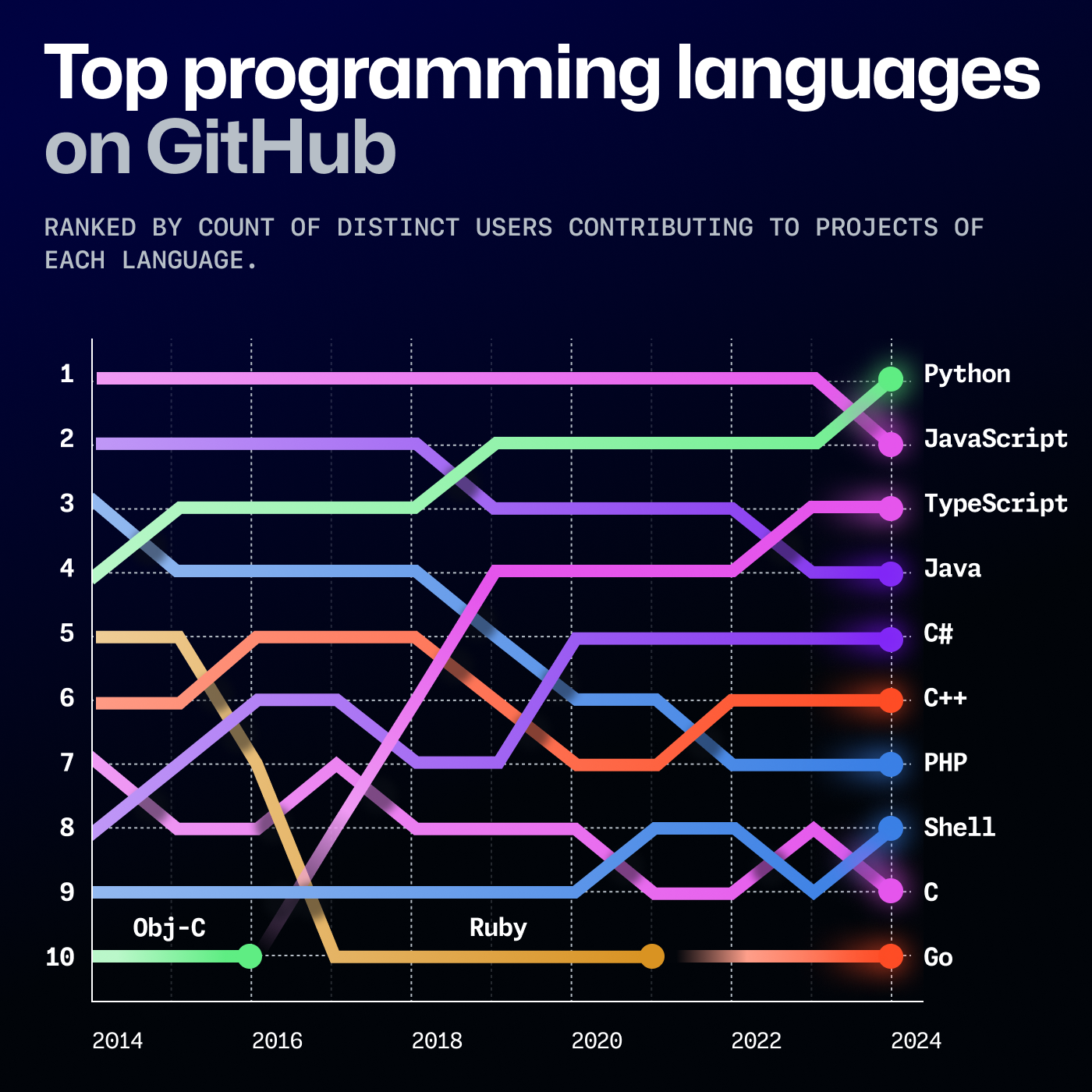
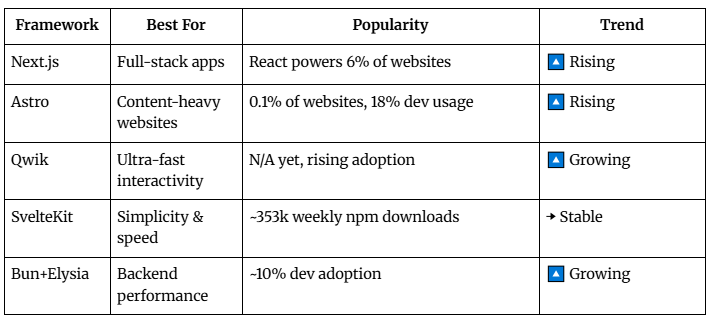
Having types flow instantly from your database schema to your UI elements, with zero setup, eliminates a whole class of bugs. In other frameworks, achieving this needs considerable setup (tRPC in) or isn't practically possible (Bed rails, Django). FeatureLaravelRuby on RailsDjangoNext.jsWaspPHPRubyPythonJavaScript/ TypeScriptJavaScript/TypeScript83K +56 K +82 K +130 K +18 K+E loquentActive RecordDjango ORMBYO (Prisma/Drizzle)Prisma (integrated)Beginner sets + WorkOS AuthKit integrationGenerator (Bed rails 8)django.contrib.authBYO (NextAuth/Clerk)Declarative configQueues + HorizonActive Job + Strong Line(Celery)BYO (Inngest/)Declarative configVia Inertia.jsVia Hotwire/APIVia different SPANative ReactNative ReactLimitedMinimalLimitedManual (tRPC)AutomaticForge/VaporKamal 2Manual/PaaSVercel (one-click)CLI release to Railway,, or any VPSModerateModerateModerateSteep (App Router)Low-ModerateLarge (PHP)ShrinkingLarge (Python)Large (React)Indirectly Huge (Wasp is React/) if you or your group knows PHP, you need a battle-tested solution for a complicated service application, and you want a huge environment with responses for every issue.
It depends on your language. The declarative config removes choice fatigue and AI tools work particularly well with it.
The typical thread: choose a structure with strong viewpoints so you spend time structure, not configuring. setup makes it the very best option as it offers AI a boilerplate-free, high-level understanding of the whole app, and allows it to concentrate on constructing your app's organization logic while Wasp handles the glue.
Yes, with cautions. Wasp is quickly approaching a 1.0 release (currently in beta), which implies API modifications can take place in between variations. Real business and indie hackers are running production applications developed with Wasp. For enterprise-scale applications with intricate requirements, you might wish to await 1.0 or select a more recognized structure.
A Strategic Guide to Select the Right CMS
For a start-up: gets you to a released MVP quick, specifically with the Open SaaS template. For a group: with Django REST Structure. For a group:. For speed-to-market in Ruby:. The common thread is selecting a framework that makes choices for you so you can focus on your product.
leads in information science, AI/ML, and lots of enterprise contexts. stays strong for firms, e-commerce, and WordPress-adjacent work. has a faithful however shrinking job market. is too new for a significant task market of its own, however Wasp skills are really Respond + + Prisma abilities all extremely marketable separately. You can, but it needs significant assembly.

Latest Posts
How Conversational Queries Affect Local SEO
Navigating New Search Signals of Future Web
Improving Search ROI Through Modern GEO Tactics